
Ultrasonic Spray Nozzles
Very fine, low-velocity droplets for thin coatings, humidification and dry-fog applications.
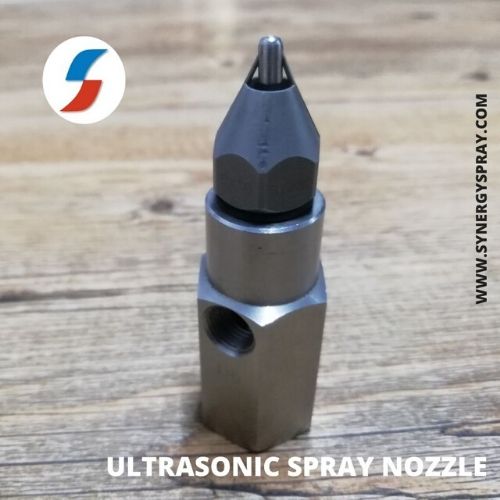
Electrically Actuated Spray Nozzles
Ultrasonic nozzles operate by converting high frequency sound waves into mechanical energy that is transferred into a liquid, creating standing waves. As the liquid exits the atomizing surface of the nozzle, it is broken into a fine mist of uniform micron sized droplets. These nozzles are also known as Electrically actuated / controlled Spray Nozzles.
The electric hydro pulse nozzle has an integrated solenoid valve to rapidly regulate the on-off cycle of the nozzle. The solenoid valve is positioned inside the nozzle so that it is very close to the orifice. This means the reaction time of the shut off system is incredibly fast. The nozzle can be cycled off and on up to 150 times per second. Its used for precision spraying applications like tablet coating.
Details
Every ultrasonic nozzle operates at a specific resonant frequency, which dictates the median droplet size. Droplet sizes have little variance, and can be mathematically calculated to fall within a tight predicted drop distribution. For example, a 120 kHz nozzle produces a median drop size of 18 microns (when spraying water). The higher the frequency, the smaller the median drop size.
Nozzles are fabricated from a very high-strength titanium alloy and other proprietary metals, making them exceptionally resistant to chemical attack and providing superior acoustical properties. The electrically active elements are contained within a sealed housing that protects the nozzle components from external contamination.
How to choose the right nozzle
Five inputs decide almost every spray nozzle selection. Tell us these and we will shortlist the model.
Spray pattern
Full cone, hollow cone, flat fan, solid jet or fine mist, chosen by the area and the job.
Flow & pressure
Required flow (LPM) at the available pressure (bar) sets the orifice size.
Spray angle & distance
Coverage width at the target distance determines angle and spacing on the header.
Droplet size
Fine for evaporation and gas cooling; coarse for impact, washing and wetting.
Material & connection
Brass, SS 304/316, PP, PVDF or PVC; thread size and type (BSP/NPT) or clip-on.
Explore related nozzles and applications

Spray Coating
Uniform, controlled coatings of release agents, oils, glazes and food coatings.
Explore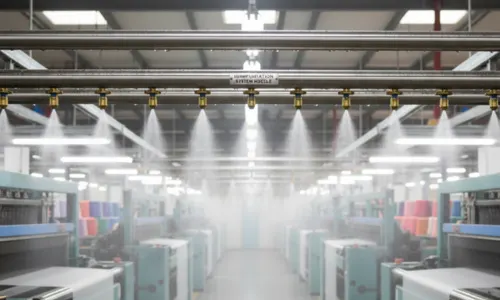
Humidification
Fine fog that raises humidity without wetting surfaces, for textiles, printing, storage and greenhouses.
Explore
Full Cone Nozzles
A solid, cone-shaped spray that covers a round area evenly. Used where uniform coverage matters: gas cooling, washing, dust suppression and scrubbers.
Explore
Flat Fan Nozzles
A tapered or even sheet of liquid for line coverage on conveyors, washers, coating lines and spray booms.
Explore
Hollow Cone Nozzles
A ring-shaped spray with smaller droplets than a full cone at the same flow. Preferred for gas cooling, scrubbing and evaporation duties.
Explore
Jet Nozzles
A concentrated, high-impact stream for cleaning, descaling and reaching distant targets.
ExploreQuestions about ultrasonic nozzles
Variable flows (pulse width modulation)?
With such fast and reactive on/off cycle times the Electric Hydropulse can achieve vary the flow from the nozzle without varying the fluid pressure. This is achieved by pulsing the nozzle very rapidly, (pulse width modulation – PWM). So, for example, a half flow could be achieved by having a 0.05 second on to 0.05 second off cycle time. This would halve the overall flow rate at any given pressure. Because the on-off cycle is so fast the resulting spray remains very evenly distributed even when targeting fast-moving conveyors.
With a normal hydraulic nozzle flow rates could only be controlled by varying the fluid pressure. This, however, will alter other important spray characteristics such as droplet size. When variable flow rates are required due to, say, different product lines, it might not be possible to achieve the required variance with a hydraulic nozzle. This would mean a nozzle change between production runs. The HydroPulse Electric will mean the same nozzles can be used despite variable dosing requirements.
Additionally, rapid pulse modulation allows for lower flow rates to be achieved when compared to traditional hydraulic nozzles. This can be important in some very low flow rate applications.
Benefits?
• Control a wide range of flow rates • Guarantee an even and uniform application rate that connects with conveyor line for automated speed adjustments • Reduce consumption of expensive coatings • Reduce overspray waste and improve product quality • Exact target coatings secure a clean and safe environment • Promote increased production • Reduce maintenance and downtime • Reliable spray dosing.
Applications?
- Application of antimicrobial agents for food safety
- Application of preservatives and mold inhibitors to help extend shelf life
- Application of egg wash
- Coat bottles to minimize scuff damage
- Apply water to balance moisture loss from the freezing process
- Apply coatings and release agents to pans, cookie sheets, and conveyors to prevent sticking
- Apply flavorings, oil, and butter to enhance the appearance and improve the taste of products
- Apply viscous coatings like syrups, glazes, and chocolate
Can you supply nozzles to match my existing ones?
Yes. Share the model or a photo, the thread size, spray angle and flow, and we will propose an equivalent.
Which material should I choose?
Brass for general water duties, SS 304/316 for corrosion and temperature, and PP, PVDF or PVC for aggressive chemicals.
Why are my nozzles clogging?
Usually from debris or scale. Add or improve filtration, choose a larger free passage design such as spiral nozzles, and clean nozzles on a schedule.
Do you supply in bulk?
Yes, we supply single replacements as well as bulk orders for OEMs and project quantities.