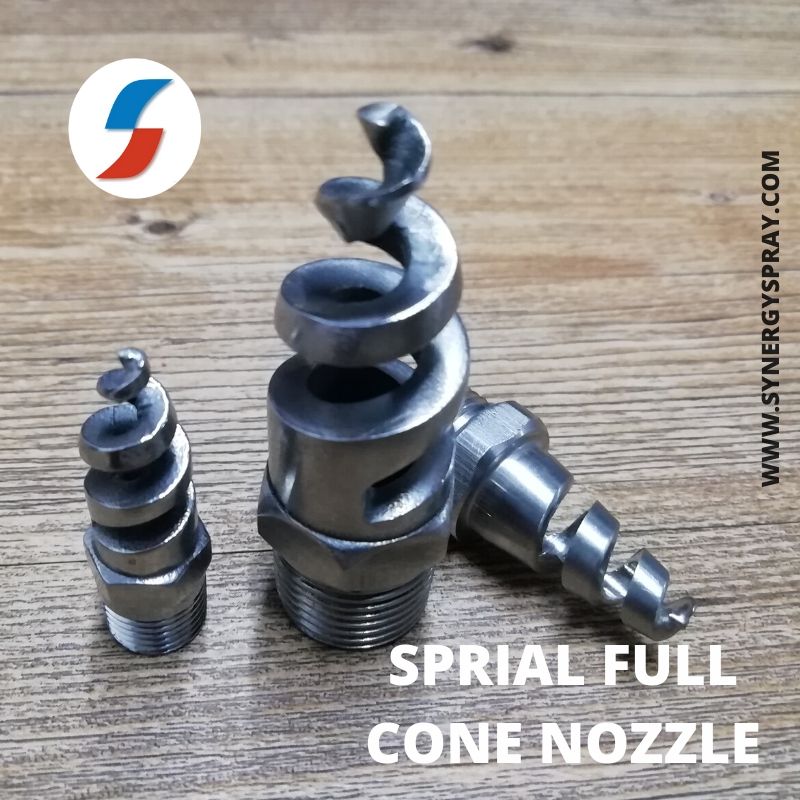
Uniform full-cone coverage, engineered around your process.
Select a full cone nozzle for washing, cooling, scrubbing, dust suppression, foam control, chemical processing or fire-protection duties. Synergy Spray can match the spray angle, flow, connection and material to the liquid and operating pressure you provide.
A filled spray pattern with a round impact area
A full cone nozzle introduces rotation or controlled turbulence before the liquid exits the orifice. The resulting spray fills the cone rather than concentrating liquid only around the perimeter. That makes the pattern useful when the process needs area coverage, heat or mass transfer, or repeatable wetting across a target.
Synergy Spray's current range includes axial-flow, tangential-flow, spiral and clustered arrangements. The appropriate design depends on the liquid, solids content, available pressure, required flow, target distance and tolerance for clogging.
- Uniform distribution: suited to processes that need liquid across the complete circular footprint.
- Material choice: listed options include brass, SS304, SS316, mild steel, Hastelloy, titanium, PVC, nylon, PVDF and PP.
- Application-specific geometry: flow, angle, orifice and internal insert can be selected or customized.
Choose the nozzle design that fits the liquid and maintenance conditions
The current product page identifies axial-flow, tangential-flow, cluster, turbulence and impact configurations. These cards reorganize that information into a faster engineering comparison.
Axial-flow full cone
Liquid passes through a central swirl chamber or X-style vane to create a controlled, filled pattern. Use when distribution precision and repeatability are the priority.
Selection focus: insert geometry, pressure, spray angle and orifice size.
Tangential-flow full cone
Liquid enters tangentially and rotates without a central swirl insert. The open passage can be helpful when the liquid carries solids or clog resistance is important.
Selection focus: solids size, passage diameter, throw and required distribution.
Cluster, spiral and high-flow arrangements
Multiple orifices or spiral geometries increase exposed droplet surface or deliver higher flow. Typical duties include gas treatment, cooling and dust suppression.
Selection focus: total flow, coverage overlap, atomization and service access.
Full cone nozzle specification guide
Use these published figures as a starting point. Final performance depends on the selected model, liquid properties, pressure at the nozzle and installation geometry.
| Spray angles | 30°, 45°, 60°, 90° and 120° are listed on the existing page. Other geometries can be reviewed against the application. |
|---|---|
| Flow range | 2 to 170 litres per minute across the listed 2 to 10 bar pressure range, depending on model and orifice. |
| Connections | 1/8″ to 1/2″ NPT, BSPT or BSP; male and female connector options are listed. |
| Materials | Brass, SS304, SS316, mild steel, Hastelloy, titanium, PVC, plastic, nylon, PVDF and PP. |
| Droplet size | Controlled by orifice diameter, pressure and internal insert. The current page notes finely atomized configurations down to approximately 10 microns. |
| Customization | Material and specification can be adapted to the fluid, temperature, corrosion conditions, flow and target coverage. |
Engineering note: pressure at the pump is not always the pressure available at the nozzle. Include line length, pipe size, elevation, filters and valve losses when sharing operating data.
Match coverage, impact and droplet size to the duty
The existing page lists surface spraying, washing, gas cooling, scrubbing, foam breaking, chemical processing, firefighting, dust suppression and water coating.
Washing and cleaning
Distribute cleaning liquid over components, surfaces or process zones with a filled circular footprint.
Cooling and quenching
Increase liquid contact across hot surfaces, condenser zones or gas streams while controlling total flow.
Gas scrubbing and foam control
Use complete coverage and selected droplet size for gas-liquid contact or foam breaking.
Dust and fire protection
Apply water across a defined area where coverage, throw and liquid volume must be engineered together.
Send four operating inputs before requesting a model
Providing the process data first reduces back-and-forth and helps Synergy Spray recommend the correct geometry rather than only the nearest catalogue size.
Liquid and temperature
Identify water, chemical, slurry or other fluid, together with concentration and operating temperature.
Required flow and pressure
Share the flow per nozzle or total system flow, plus the pressure expected at each nozzle.
Coverage and distance
Provide target width or diameter, nozzle-to-target distance, mounting orientation and overlap.
Connection and material
Specify thread standard, size and the material compatibility required for corrosion and wear.
Current full cone products
This block resolves products by their existing WordPress slugs. Product titles, images, links and availability are rendered by WooCommerce at page load, so catalogue changes do not require editing this page.
Full cone nozzle selection questions
These answers reorganize the technical information on the existing page. A final recommendation still requires the actual liquid, pressure, flow and coverage data.
How does a full cone nozzle work?
An internal vane, swirl chamber, tangential inlet, spiral or impact geometry introduces rotational or turbulent energy. The liquid exits as a cone whose footprint is filled rather than hollow.
When should I choose tangential flow?
Tangential-flow designs can provide an open internal passage without a swirl insert. They are often considered when the liquid contains solids or clog resistance is a priority.
Which material should I specify?
Material selection depends on corrosion, temperature, pressure, wear and hygiene requirements. The listed range includes metals and engineering plastics; compatibility must be checked against the actual fluid.
Can the flow rate and spray angle be customized?
Yes. The existing page states that materials and specifications can be customized. Share the required flow, pressure at the nozzle, target coverage and connection so the geometry can be reviewed.
What causes an uneven full cone pattern?
Common causes include insufficient pressure, blocked or worn passages, damaged inserts, unstable upstream flow, solids larger than the passage, or incorrect nozzle spacing. Inspect the complete installation rather than the nozzle alone.
Share the liquid, flow, pressure and coverage target.
Synergy Spray can review the operating data and recommend an axial, tangential, spiral or clustered full cone arrangement, together with the connection and material.