
Mist & Fogging Nozzles
Fine-orifice nozzles that turn pressurised water into a flash-evaporating fog for cooling, humidification, dust and odour control.
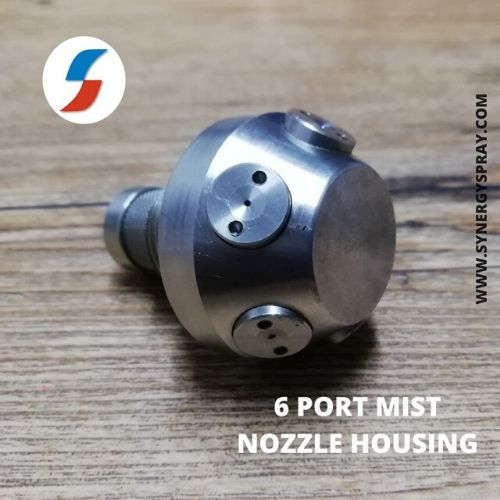
SYNERGY SPRAY SYSTEM , we are a top-rated producer and distributor of high-quality fine fog and mist nozzles in India, available at the most competitive prices. Our extensive range comprises mist nozzles made of stainless steel, brass, and plastic, which can be tailored to meet our customers' specific requirements. We offer a variety of high-pressure, medium-pressure , and low-pressure mist fog nozzles to suit different applications.
High Pressure Fog Spray Nozzle
Mist & Fog Nozzles can produce either a full cone or hollow cone pattern that, at a certain distance from the orifice, will break down into a fog or mist when operated at a certain pressure. Some nozzles are specifically designed to produce this effect. Mist nozzles are often referred to as fog nozzles because the terms are interchangeable in various applications. The liquid particles that are ejected from the orifice can be classified as mist, fog, or spray depending on their particle size, measured in microns. For more information on selecting the appropriate nozzle for a specific application, please see below.
Fine Mist Spray Nozzle
A mist pattern is characterized by a low flow rate of very small droplets that have minimal impact. This pattern is commonly used in applications where evaporation cooling, moistening, or humidifying is required. As liquid pressure increases, a hydraulic nozzle will produce finer and finer droplets. For example, a nozzle that produces a mist at 5 bar pressure may produce a fog when spraying at 15 bar pressure. As a result, the terms fog nozzle and misting nozzle are often interchangeable because the same nozzle can produce both a mist and a fog, depending on the operating pressure.
In addition to high-pressure misting nozzles, we also manufacture low-pressure misting nozzles with push-fit connections. These nozzles are available in 6 mm, 8 mm, 10 mm, and 12 mm connections.
Mist Nozzle for Dust Suppression
We are a leading manufacturer of mist nozzles designed for dust suppression. These nozzles produce extremely fine particles of less than 15 microns, allowing for precise and efficient dust suppression in a variety of settings, whether indoors or outdoors, on a large or small scale.
Our dust suppression misting nozzles are technologically advanced, energy-efficient, and highly customizable to meet the specific needs of your application. While dust suppression is a common use for our systems, they are also used in a wide range of other applications, and we are constantly discovering new ways in which our fog technology can be utilized.
Our misting systems for dust suppression have been successfully implemented in a variety of industries, including potato grading and packing facilities and power stations with wood pellet storage areas.
Our dust suppression mist nozzles are available in a range of orifice sizes, including 0.10mm, 0.15mm, 0.20mm, 0.30mm, 0.40mm, 0.50mm, and 0.60mm. These cleanable anti-drip nozzles are built to last and can handle even corrosive and high-viscosity liquids, making them suitable for use in a variety of applications such as mid/high-pressure misting systems, mosquito/insect control systems, odor control, and special effects.
This misting nozzle features a built-in anti-drip mechanism and has a standard orifice size of 0.30mm. It is suitable for moderate flow applications and produces small droplets ranging from 1.6μ to 39.1μ with a spray diameter of between 65-75 degrees. It is recommended to use this nozzle at pressures of 100 psi or more and is commonly used for outdoor cooling. High-pressure springs require 250 psi to open, while low-pressure springs require 65 psi to open, with a recommended pressure of 100 psi.
Misting / Fog Nozzles Characteristics:
- Cleanable
- Stainless Steel Orifice
- Fine Atomization
- 3/16 Thread
- Stainless Steel Body
Dry Fog Nozzle
Dry fog nozzles are often used in industrial settings, such as mines, quarries, and construction sites, where dust suppression is necessary to maintain a safe and healthy work environment.
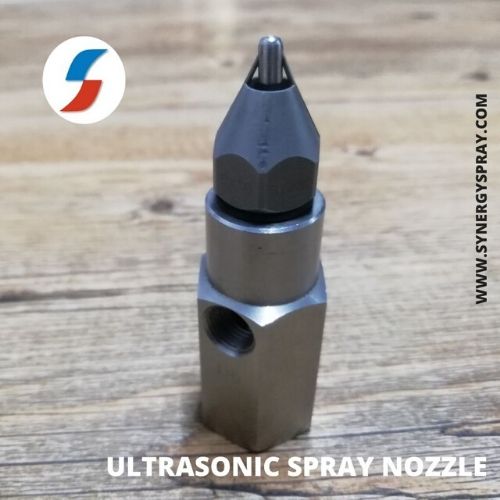
Dry fog nozzles utilize a combination of compressed air and pressurized water to atomize fluids at low pressure. The optimal operating pressure for water is typically between 1 to 3 kg/cm2 (15 psi to 45 psi), while air pressure ranges from 3 to 5 kg/cm2 (45 psi to 75 psi). These nozzles can have a flow rate as low as 6 LPH to 36 LPH (Liters Per Hour). They are commonly used for a variety of applications, including dust suppression, coating, cooling, lubrication, misting, and fogging.
How to choose the right nozzle
Five inputs decide almost every spray nozzle selection. Tell us these and we will shortlist the model.
Spray pattern
Full cone, hollow cone, flat fan, solid jet or fine mist, chosen by the area and the job.
Flow & pressure
Required flow (LPM) at the available pressure (bar) sets the orifice size.
Spray angle & distance
Coverage width at the target distance determines angle and spacing on the header.
Droplet size
Fine for evaporation and gas cooling; coarse for impact, washing and wetting.
Material & connection
Brass, SS 304/316, PP, PVDF or PVC; thread size and type (BSP/NPT) or clip-on.
Explore related nozzles and applications
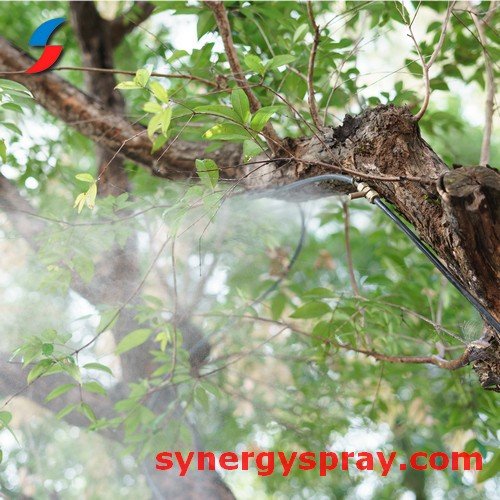
Misting & Fogging
High-pressure pumps, fine mist nozzles and controls engineered as one system, for cooling, humidification, odour and dust control.
Explore
Dust Suppression
Droplets capture airborne dust best when they are close to the dust particle size. Here is how nozzle choice, pressure and placement affect results.
Explore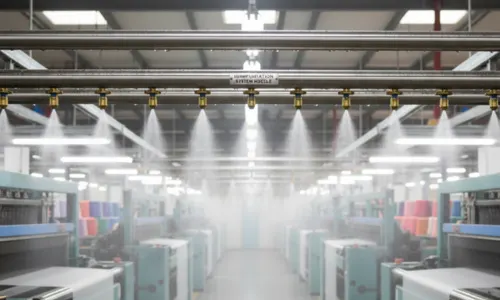
Humidification
Fine fog that raises humidity without wetting surfaces, for textiles, printing, storage and greenhouses.
Explore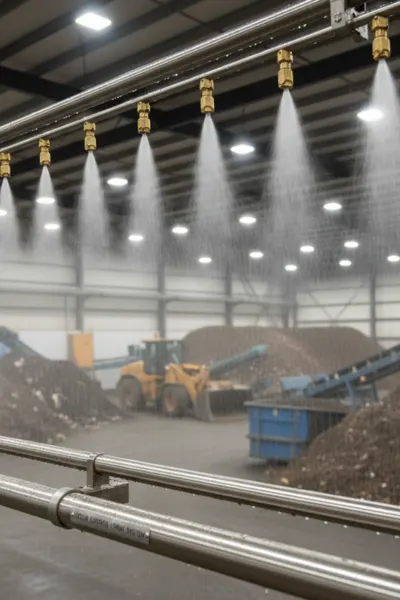
Odour Control
Neutralising agents atomised into fine mist that meets odour molecules in the air at landfills, STPs and transfer stations.
Explore
Full Cone Nozzles
A solid, cone-shaped spray that covers a round area evenly. Used where uniform coverage matters: gas cooling, washing, dust suppression and scrubbers.
Explore
Flat Fan Nozzles
A tapered or even sheet of liquid for line coverage on conveyors, washers, coating lines and spray booms.
ExploreQuestions about mist nozzles
Fog nozzles and misting nozzles?
The full cone or hollow cone pattern produced by many nozzles will break down into a fog/mist after a certain distance from the orifice. If a cone pattern is desired then this breakdown into a true mist is not desirable. But for some applications, the breakdown of the spray into a true homogeneous fog is the required result. As such, there are a number of nozzles that are designed to specifically produce this effect.
A mist pattern is characterized by having a low flow rate of very small droplet sizes with almost no impact. Typically this pattern will be used for evaporation cooling, moistening and humidifying applications.
Fog, mist or spray?
Fog, mist or a spray are classified based on the mean droplet size.
- Dry fogs will have Sauter mean droplet sizes up to 20 microns
- Wet fogs will have Sauter mean droplet sizes between 20 and 30 microns
- Mists with have Sauter mean droplet sizes between 30 and 60 microns
- Spray particles above 60 microns is classifed as spray.
A hydraulic nozzle will produce finer and finer droplets as liquid pressure is raised. So a water mist nozzle that produces a mist at 5 bar pressure may well produce a fog spraying at 15 bar pressure. This means the term fog nozzle and misting nozzle are generally interchangeable as the same nozzle may well be able to produce both a mist or a fog depending on the operating pressure.
Mist / Fog nozzle design variants
There are three common designs of hydraulic misting nozzle:
Small orifice misting nozzles operate by forcing fluid through a very small orifice. The sheering forces break the fluid into fine droplets.
Impingement misting nozzles operate impacting the fluid on pin just underneath the exit orifice. This breaks the liquid into very fine droplets.
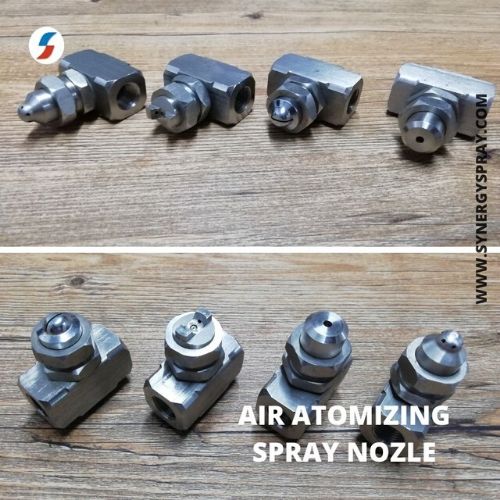
Further to this air atomising nozzles are also commonly used for mist and fog generation. These pneumatic nozzles use compressed air to break apart the fluid being sprayed allowing for very fine atomisation even at low fluid pressures. Air atomising nozzles can produce a variety of different initial spray patterns but due to the fine droplet size at a certain distance from the nozzle these will form fogs or mists.
Misting nozzles create a very fine mist or fog. Droplets are typically small enough allowing drops to float. Misting nozzles function in cooling by atomizing pressurized water into aerosol particles. so it can be used in wide range of application.
Anit Drip Fog / Mist Nozzles?
Anti drip fog and mist nozzles helps save the liquid especially water when the pressure pumps are not in operation. it serves the dual purpose of saving water as well as prevention of floor wetting. This mechnism has a spring loaded with the stopper which gets activeed when the misting lines are pressurized. At normal pressure, its closed.
Nature and Uses of Misting Nozzles:?
When the water flows through the nozzles, it evaporates. This process is known as flash evaporation. It is because of this process of flash evaporation that the mist is created, which is responsible for cooling the area.
Some misting nozzles also contain a filtration system that can catch hold of the fine sediment particles that may lead to clogging. A few high quality nozzles have a dual filter system.
One thing that has to be kept in mind is that these nozzles have to be regularly cleaned. Not doing so may lead to severe clogging. Moreover, if broken, they would have to be changed or replaced.
When cleaning a nozzle, it is advisable to remove it and keep it in a bowl containing a solution of vinegar and water. These can also prove to be efficient in eliminating debris, if any.
If you opt to clean the nozzles with the vinegar solution, make sure you soak the nozzle overnight. After doing this, all you need to do is remove the sediment particles with a slight tap. In order to get rid of clogging, you can use a brush or a smooth cloth rather than a sharp implement.
There are two popular basic types of mist nozzles that are available in the market – brass and ceramic. The brass nozzles are entirely made of brass and have stainless steel tips and are known for providing reliable performance for a long time. Ceramic nozzles a made through a combination of a ceramic insert or entirely with ceramic material. These nozzles are commonly used along with high pressure misting fans to provide the finest mist possible.
These nozzles come in variety of orifice sizes. They are effective even at extreme PSI levels varying from 30 to 1500.
Low pressure misting nozzles come in many different forms of quality; make sure that your nozzles are brass with a stainless steel insert tip. Many companies sell cheaper, plastic nozzles and brass nozzles without a stainless steel tip and the quality is not as good.
All our nozzles are manufactured using industry standard materials and nozzles lasts longer.
Application 😕
- Dust Control and Suppression
- Gas Scrubbing
- Lubrication
- Painting
- Cleaning / Washing
- Coating
- Aeration
- Greenhouse
- Climate Control
- Pollution Control
- Fine Spraying
- Fogging
- Sanitizing
- Many More
Can you supply nozzles to match my existing ones?
Yes. Share the model or a photo, the thread size, spray angle and flow, and we will propose an equivalent.
Which material should I choose?
Brass for general water duties, SS 304/316 for corrosion and temperature, and PP, PVDF or PVC for aggressive chemicals.
Why are my nozzles clogging?
Usually from debris or scale. Add or improve filtration, choose a larger free passage design such as spiral nozzles, and clean nozzles on a schedule.
Do you supply in bulk?
Yes, we supply single replacements as well as bulk orders for OEMs and project quantities.