
How to Select a Spray Nozzle: A Step-by-Step Guide
A practical guide to selecting an industrial spray nozzle: spray pattern, flow and pressure, angle and coverage, droplet size, material and connection.
Most nozzle problems come from a mismatch between the nozzle and the duty. Work through these steps and you will have everything needed for a correct selection.
1. Define the job
Write down what the spray must achieve: clean, cool, coat, humidify, scrub or suppress dust. This decides the pattern and droplet size range.
2. Choose the spray pattern
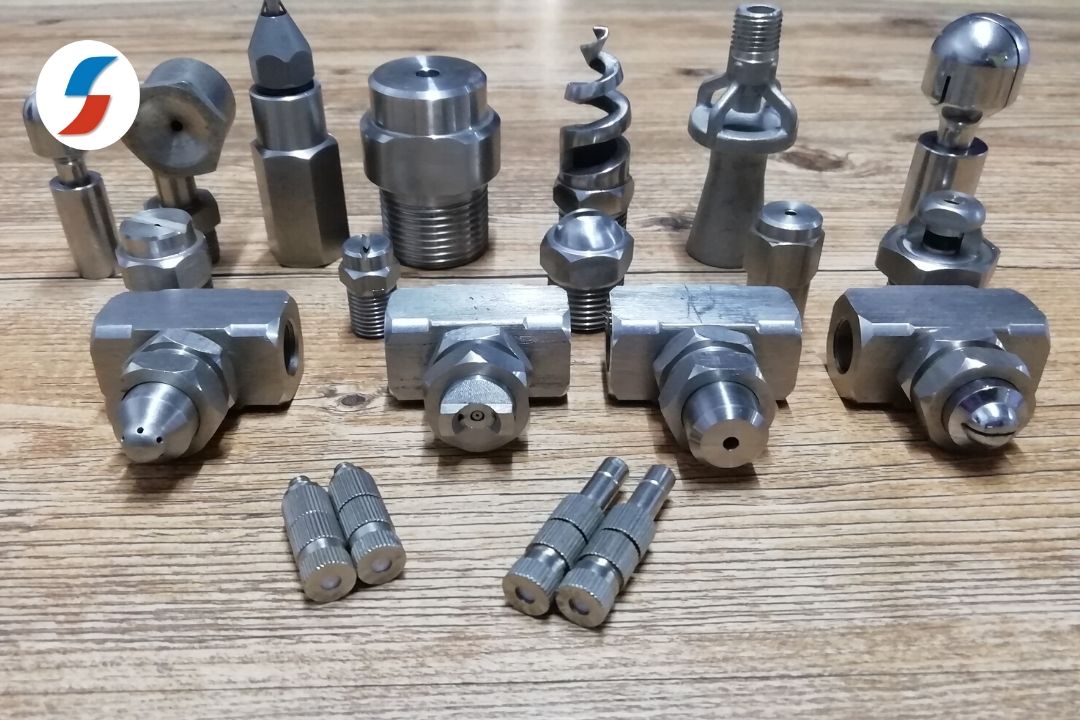
Full cone for even round coverage, hollow cone for finer droplets, flat fan for line coverage along a header, solid jet for impact, and fine mist for evaporation. See types of spray nozzles.
3. Fix flow and pressure
Decide the flow per nozzle (LPM) at the pressure available at the nozzle, not at the pump. Pressure losses in pipes and filters matter.
4. Check angle, distance and spacing
Coverage width equals roughly twice the distance times the tangent of half the spray angle, before gravity and air movement. Overlap adjacent sprays where uniformity matters.
5. Match droplet size to the process
Smaller droplets for evaporation and gas cooling; larger ones for washing and wetting.
6. Select material and connection
Brass, SS 304/316, PP, PVDF or PVC by liquid and temperature; BSP or NPT thread, or a clip-on for headers.
7. Plan for maintenance
Add filtration sized to the smallest passage and plan nozzle inspection. Worn orifices raise flow and spoil the pattern.
Related solutions
Spray Nozzles
Choose by spray pattern, flow, droplet size and material. Every nozzle family below links to its application guide, product range and a quick RFQ.
Explore
Full Cone Nozzles
A solid, cone-shaped spray that covers a round area evenly. Used where uniform coverage matters: gas cooling, washing, dust suppression and scrubbers.
Explore
Flat Fan Nozzles
A tapered or even sheet of liquid for line coverage on conveyors, washers, coating lines and spray booms.
Explore
Hollow Cone Nozzles
A ring-shaped spray with smaller droplets than a full cone at the same flow. Preferred for gas cooling, scrubbing and evaporation duties.
Explore